Startup Stories
Rapido Startup Story: How Three Friends Turned a Failed Idea Into a $3 Billion Mobility Company
By Ananya Varma
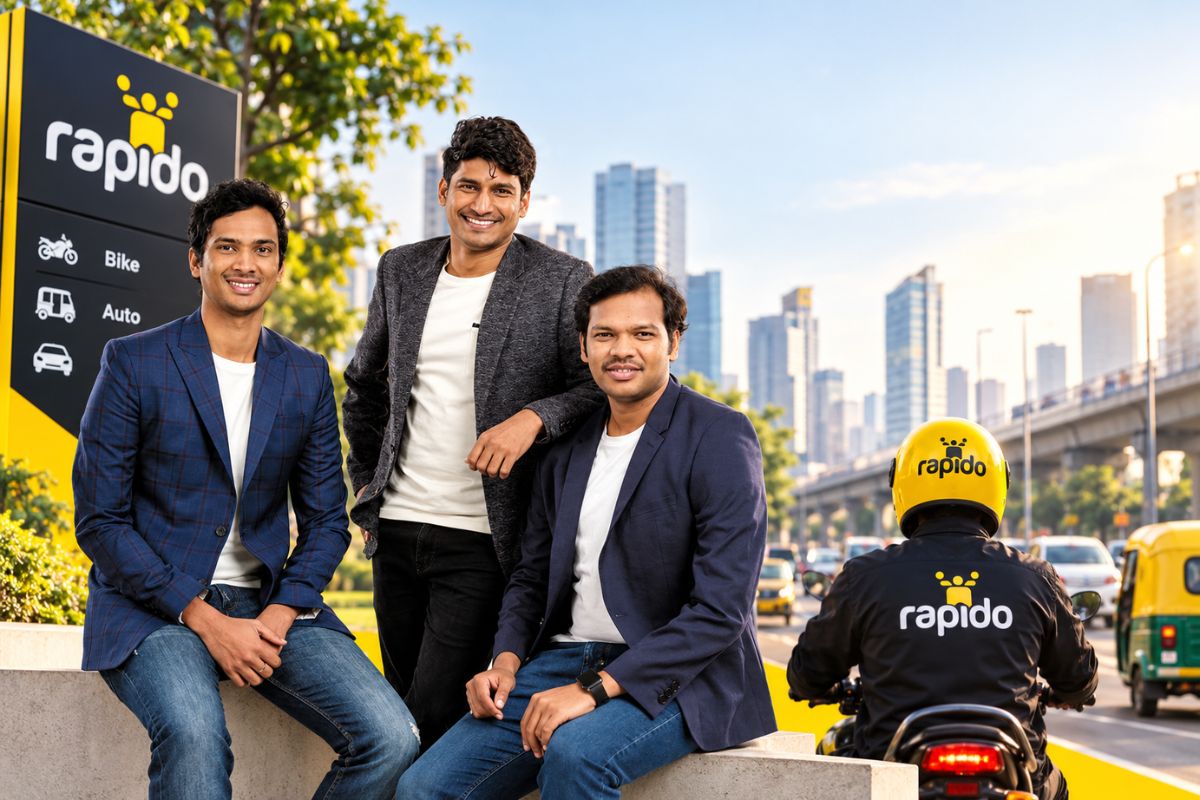
When Aravind Sanka, Pavan Guntupalli and Rishikesh S R started their entrepreneurial journey, they were not trying to build one of India's biggest mobility startups.
Their first venture, theKarrier, focused on logistics. When that business failed to scale as expected, the founders went back to the drawing board.
Instead of abandoning the mobility sector, they looked at a problem millions of Indians faced every day: traffic, expensive cab rides and the difficulty of travelling short distances quickly.
That observation eventually led to Rapido, which was founded in 2015. More than a decade later, Rapido has grown into a major Indian mobility platform, operating across more than 400 cities and reaching a $3 billion valuation in 2026.
The idea behind Rapido
When Rapido's founders looked at India's transportation market, they saw a major gap.
Cab-based ride-hailing was already being dominated by companies such as Ola and Uber. But a large section of India's population could not afford to use cabs regularly.
The founders realised that a motorcycle could solve two problems at the same time.
It could move through congested roads more easily than a car and could provide a significantly cheaper option for short-distance travel.
As Aravind Sanka explained to Fortune India, the founders believed that two-wheelers could help them serve a much larger population beyond the biggest metropolitan markets.
That became the foundation of Rapido's business model.
Before Rapido came theKarrier
Rapido's success story actually began with failure.
Before launching Rapido, the three founders had created theKarrier, a logistics and transportation venture.
The business gave them valuable exposure to the challenges involved in moving goods around Indian cities, but the founders eventually concluded that they needed to rethink their approach.
Rather than treating the failure as the end of their entrepreneurial journey, they used what they had learned about transportation, drivers, customers and city infrastructure to identify a different opportunity.
They shifted their attention from moving goods to moving people.
The change in direction eventually produced Rapido.
Why bikes became the answer
The founders noticed something simple about Indian cities.
Cars could spend significant amounts of time stuck in traffic, while motorcycles could navigate crowded roads much more efficiently.
At the same time, owning and operating a two-wheeler was considerably cheaper than running a car.
That created an opportunity to offer consumers an affordable alternative to conventional cab services.
The model was simple: connect passengers who needed short-distance transportation with motorcycle riders through a mobile application.
Rapido called its driver-partners “Captains.”
Starting in Bengaluru
Rapido launched in Bengaluru in 2015.
The early team was extremely small. According to Pavan Guntupalli, the company's first 50 Captains included around 20 people from the company itself, including founders and sales employees who participated in rides and helped build the service from the ground up.
The founders had to convince both customers and riders that a bike-taxi service could become a practical form of urban transportation.
It was not an easy sell.
Bike taxis were a relatively unfamiliar concept, and regulations surrounding them varied between states.
But the founders continued expanding their model one market at a time.
Investors initially had doubts
Rapido's early journey also involved significant fundraising challenges.
The company's founders were entering a market where established companies had already raised substantial amounts of capital.
Convincing investors to back a bike-taxi company was difficult.
Pavan Guntupalli later spoke about his entrepreneurial journey and the difficulties involved in raising capital. Rapido's founders nevertheless continued developing the business and demonstrating that there was demand for affordable two-wheeler transportation.
Over time, investors began to see the potential in the model.
Building the Captain network
One of Rapido's biggest advantages became its ability to build a large network of driver-partners.
Instead of owning a fleet of motorcycles, the company created a technology platform connecting customers with independent Captains.
This asset-light approach allowed Rapido to expand without having to purchase and maintain millions of vehicles itself.
The model also created an opportunity for motorcycle owners to generate additional income by offering rides through the platform.
Expanding beyond bike taxis
Rapido did not remain a bike-taxi company forever.
As the platform grew, it expanded into auto-rickshaw and cab services, allowing customers to choose different forms of transportation through the same platform.
The company also expanded into other mobility and delivery-related services.
By 2026, Rapido was operating in more than 400 Indian cities, with services spanning bikes, autos, cabs and other mobility offerings.
The expansion transformed Rapido from a niche bike-taxi startup into a broader mobility platform.
From startup challenger to major mobility player
Rapido's growth has also changed the competitive landscape of India's ride-hailing industry.
The company originally entered a market dominated by larger players, but its focus on affordable two-wheeler transportation allowed it to establish a distinct position.
Its expansion into autos and cabs has brought it into more direct competition with established ride-hailing companies.
The company has also continued to deepen its presence outside India's biggest metropolitan areas, where demand for affordable transportation remains strong.
Rapido raises $240 million at $3 billion valuation
In May 2026, Rapido announced a fresh $240 million funding round led by Prosus, with participation from existing investors including WestBridge Capital and Accel.
The investment valued Rapido at approximately $3 billion, up from around $2.3 billion during an earlier secondary transaction.
The funding was part of a larger $730 million primary and secondary financing.
Rapido said the new capital would be used to expand into high-growth markets, strengthen its driver network and invest in technology and platform efficiency.
Why the Rapido story matters
Rapido's journey offers an important lesson for entrepreneurs.
The company did not emerge from a perfect first idea.
The founders had already experienced the difficulties of building their earlier logistics venture.
Instead of starting over in an unrelated industry, they used the knowledge they had gained from their first attempt to identify another problem within the same broad sector.
They then started with a relatively simple proposition: make short-distance travel faster and more affordable using two-wheelers.
That simple idea became the foundation for a much larger mobility business.
The lesson for entrepreneurs
The Rapido story shows that a failed startup does not necessarily mean the end of an entrepreneurial journey.
Sometimes, failure provides the experience needed to identify a better opportunity.
Rapido's founders saw an overlooked segment of the transportation market and built around the realities of Indian cities rather than trying to replicate the conventional cab model.
Their journey—from theKarrier to Rapido, from a small Bengaluru operation to a platform valued at $3 billion—is a story of persistence, adaptation and understanding what customers actually need.
For aspiring entrepreneurs, perhaps the biggest lesson from Rapido is simple:
A failed idea can become the foundation for a better one—if you are willing to learn, adapt and try again.